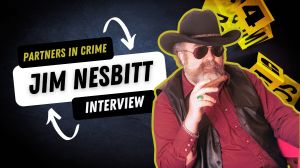
Wanna see what makes your ol’ pal Honest Jim tick? To get a terrifying glimpse of how my mind works and the inner dialogue I constantly have about writing those Ed Earl Burch hard-boiled crime thrillers, check out this feisty Q&A book blogger Cheryl Masciarelli hit me with as part of her Partner In Crime Tours showcase of THE FATAL SAVING GRACE.
Here’s the intense grilling Cheryl inflicted upon me:
What was the inspiration for this book?
A perverted sense of charity for the main character of my hard-boiled Texas crime thrillers, cashiered Dallas homicide detective Ed Earl Burch. For two decades, he’s been wandering the peephole wilderness of a private detective, longing for the sense of calling and higher purpose he had when carried the badge he lost. I wanted to give him what he wished for and see how he copes with life as a resurrected lawman, forced to take orders and work with people after living life as a loner and semi-outlaw for a long time. It’s not everything he hoped it would be, as is often the case with magnificent obsessions. Too many rules, too many people, too many years as a lone wolf and semi-outlaw unfettered by rules. I also wanted to show the hard miles he’s racked up, giving him the aches and pains of middle-aged tough guy without turning him into a cripple or a poster child for Geritol. He’s still tough, profane, ornery and reckless. And he’d still just as soon shoot you as look at you — if you’re a bad guy in need of killin’. But it’s harder for him to get out of bed in the morning.
What was the biggest challenge in beginning your writing career?
Getting started. I come from a long line of hillbilly storytellers who taught me the importance of knowing where you’re from and who your people are. Seems like I’ve always had a book in my hand and started writing at a very early age. Had some talent and was able to parlay it into a fairly successful journalism career for nearly forty years. I was lucky to break into journalism when long-format stories that used the tradecraft of fiction writing was in vogue. I was also a hard-boiled crime fiction junkie, a faithful follower of Chandler and Hammett and others who broke free from the confines of the English cozy mystery and amateur sleuths, giving crime back to the criminals of the gritty urban underworld. Wasn’t a huge leap for me to tackle my first hard-boiled crime thriller. But I’m a lazy bastard so it took me way too long to start. Wish I’d cranked it up twenty years ago. Make that twenty-five.
What do you absolutely need while writing?
Used to be George Dickel Tennessee whisky (spelled without the e), preferably hundred proof bottled-in-bond, and a damn good cigar, waiting for me at the end of a writing session. These days, it’s more likely to be cornbread and iced tea, to poach a line from Hank Williams, Jr. And a cushion for my butt.
Do you adhere to a strict routine when writing or write when the ideas are flowing?
I’m not really strict about anything and I hate routine. That said, I know the key to writing a book is the discipline to keep your butt in the chair for hours at a time and writing even when the words don’t flow. If you wait on those mystical ideas to flow, you’ll never get anywhere. I don’t punch a clock or slavishly do periodic word counts but I do put in the time it takes to write a good story. I just don’t brag about it on Facebook or my blog.
Who is your favorite character from your book and why?
Rhonda Mae Mutscher. She’s just as tough and unsinkable as Ed Earl Burch. Maybe tougher. Quicker to shoot somebody, maybe. Very much like many of the women in my books, she’s smarter than most men, Burch included. But there’s a bond between her and Burch based on the earlier experience of him helping her escape from cartel sicarios and gunrunning rivals, including the serial killer of this book, a nasty piece of work named Cleve Chizik, who Burch thought he killed during a desert shootout four or five years ago described in The Dead Certain Doubt. Because of that bond, she thinks of Burch when Dixie Mafia gunsels sent by her incestuous father chase her out of the small Colorado town where the feds stashed her as a protected witness. She also has a five-year-old son she has to protect and doesn’t trust the feds to keep her or him safe. West Texas feels safer because Burch and the family of her son’s dead father are there.
Tell us why we should read your book.
Because it bristles with relentless action, has a pulse-racer of a plot, a solid storyline, and a colorful cast of characters. It’s hard-boiled detective fiction at its finest, centered on a protagonist like no other, the deeply flawed but wildly compelling Ed Earl Burch. It’s a taut, tense, uncompromising tale of revenge and redemption — a damned good story exceptionally well-told.
Give us an interesting fun fact or a few about your book?
To give myself a little more literary license, I created two West Texas jurisdictions that are both figments of my imagination: Cuervo County, because crows are smart and fascinating birds, and the town of Faver, the county seat, named for the pioneering cattle baron of the Big Bend Country, Milton Faver. Faver was an interesting character who is mostly forgotten today. Like a lot of newcomers to Texas, both before the split from Mexico and after, he was escaping something unsavory back east. He killed a man in a duel in Missouri and fled, first to Mexico, where he worked in a flour mill than as a freighter hauling goods over the Chihuahua and Santa Fe trails, surviving an Indian attack that left him severely wounded. Although hazardous, the freighting business was profitable enough for Faver to start a general store in Ojinaga. In 1857, he moved with his wife and only son to the frontier of the Chianti Mountains in the Big Bend Country, bought land around three springs and established the Cibolo Creek ranch, building herds of cattle and sheep as well as fortress houses to repel attacks from raiding Comanche and Apache. He ruled his ranches with an iron hand and meted out justice by his own lights. He didn’t believe in credit and stood at the gate during a cattle sale, taking silver coin for each cow, steer or sheep as it passed into the corral. He died in 1889.
Do you have anything specific that you want to say to your readers?
Like my earlier books, The Fatal Saving Grace is the polar opposite of a cozy mystery. There isn’t a lick of cuteness in it. It’s a hard-bitten tale told in the hard-boiled style of Chandler, Hammett and later-day writers like the late, great James Crumley. It’s raunchy and violent with no punches pulled or euphemisms used to protect delicate sensibilities. And most of the people rambling around the stark, harsh beauty of West Texas have been honed, beaten and shaped by this land. They’ve all got some hard bark on them. And even the good guys have a mean streak and do bad things to get the job done according to what they think is right. It’s country that demands rough justice and Ed Earl Burch has been given a badge again to deliver just that.
Tell us a little about yourself and your background?
The Irish say that writers are failed talkers — guilty as charged since I always tell people it’s a damn good thing I write better than I talk because the way I talk is a curious mixture of 40s and 50s tough-guy jargon and cowboy lingo. I was born up North, near Philadelphia, but my parents were both North Carolina hillbillies from around Asheville. My sister and I weren’t Yankee-raised and we spent a lot of time with the country cousins when we were young during extended summer road trips. I was a journalist for almost forty years, nearly twenty of that spent as a roving correspondent for newspapers and wire services, parachuting into big stories of the moment, from presidential campaigns to hurricanes, and chasing big trends like the ongoing battle over public land use in the West, a vicious and long-running fight about grazing rights, mining and logging, or the rise of neo-Nazis and Christian Patriots in the mountain West. That experience taught me to look for the telling detail and listen for the voices of the people swept up in an event. I was also fascinated by the features of the land where people lived and the impact of that place as they tried to extract a living from it. That fascination is very much a result of my parents instilling in me a keen sense of place — knowing where you’re from and who your people are — something I believe is vitally important in storytelling. The place where you set your story should be as alive and vivid as you can make it — a character unto itself, not a one-dimensional stage flat in a play.
What’s next that we can look forward to from you?
I’ve been accused of writing thinly disguised Westerns and, truth be told, that’s a strong undercurrent that threatens to break the surface in all my books. Ed Earl Burch doesn’t wear a white hat, but he has a code he tries to live by and a strong sense of right and wrong. I’ve decided to let him rest a bit and resume writing a Western set in the 1920s in one of the rowdy oil boomtowns of the Texas Panhandle. I’ve created a character I think fans of Ed Earl Burch will like, a morally ambiguous gypsy lawman named Charley Mack Kincaid, whose been a cowhand, a deputy, a Texas Ranger and a Pinkerton agent, tapped by a Ranger styled after the legendary Frank Hamer to go undercover and help bust open the ring running the town. I’ve also got two more Ed Earl Burch novels rattling around my brainpan that I’ll get around to writing after I finish this Western, tentatively titled Boomtown Blood, which is the most unambiguous and straightforward title I’ve ever created. Gotta do something about that.
Link to Cheryl’s blog: https://cmashlovestoread.com/2026/02/25/the-fatal-saving-grace-by-jim-nesbitt-authorinterview/
Go buy my book: https://www.amazon.com/Fatal-Saving-Grace-Hard-Boiled-Thrillers/dp/0998329479
Discover more from Jim Nesbitt
Subscribe to get the latest posts sent to your email.
 Jim Nesbitt