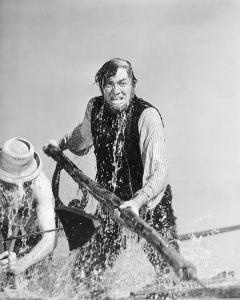
The headline above is the iconic first sentence of Herman Melville’s Moby Dick.
Reams of critical essays and analysis have been written about this enigmatic opening and its connection to the larger themes of Captain Ahab’s obsessive and doomed hunt for the great white whale — identity, power and the quest for dominion over the natural world.
Sample a few. Then try to tell me that a character’s name doesn’t matter.
Even so, authors can get themselves wrapped around the axle about character names.
A writer buddy who gave a very detailed and knowledgeable critique of one of my novels pointed out that all my characters have unique and memorable names and nicknames and thought I should visit this issue to make sure it wasn’t a distraction.
I was somewhat taken aback because I’d never even thought about names getting in between the reader and the story I was trying to tell. In fact, I regard character names and nicknames as another opportunity to show who these folks are. It’s a calling card for the reader, another piece of the puzzle.
But when I mentioned this critique in my blog, I was again surprised that other writers carefully weigh the names of their characters with one saying that for every unique name or nickname he gives a character, he balances that out with four or five less colorful handles. I find that far too formulaic and very likely to stifle creativity and short-change the story.
Then I started looking at the character names of writers I admire.
The late, great James Crumley has Milo Milodragovitch. That’s a mouthful in any language, including the Russian of Milo’s bloodline. It signals bearish strength and an endless reservoir of self-destructive behavior balanced by a determination to right the wrongs he sees.
James Lee Burke has Dave Robicheaux and all his Cajun and Big Easy characters whose names and nicknames drip with local color, gutter irony and gallows humor. They add to the stories Burke tells and are the polar opposite of a distraction. They also open the door to backstory in a colorful way that adds depth to even secondary characters — something a lot of writers fail to do.
The same applies to the stories I try to tell. My characters are Texans, Mexicans and Southerners. Most aren’t particularly nice people; even the good guys are semi-sketchy. Heaven knows my main character, Ed Earl Burch, isn’t a saint.
And I’m not really sure I can take credit for the handles they carry. Their names and nicknames seem to have been already attached as they rose from the blank pages and shoehorned themselves into the time and the places of my stories.
Ed Earl is a Texan, living in a state where a lot of men and women go by bobtailed versions of their first and middle names. Don’t call him Ed. Call him Burch or Ed Earl. That signals the reader that he’s a Texan and resonates with the strong sense of Lone Star place I try to create.
Or hang a nickname on him — Carla Sue Cantrell, a Tennessean by way of North Dallas who has a mortal lock on Ed Earl’s heart, calls him Big ‘Un. By the way, don’t call her Carla or Sue — she’ll shoot you. With a Colt 1911, the same type of gun Ed Earl carries.
To wrap up this riff, I see no reason to give a character a dull name to fit some silly template or bogus writing rule. You’re wasting another chance to show who your characters are.
Hard enough to hook a reader as it is. You don’t want to bore them into dumping your book in the trash can.
Call me Ed Earl’s daddy.
This is a guest post I wrote for one of the whistlestops on the Partners In Crime Tours blog tour for my latest hard-boiled Texas crime thriller, THE FATAL SAVING GRACE.
Click this link to see the post, the book showcase and a giveaway with the chance to win one of two $25 Amazon gift cards: https://www.booksrusonline.com/2026/02/guest-post-call-me-ishmael-by-jim.html
Discover more from Jim Nesbitt
Subscribe to get the latest posts sent to your email.
 Jim Nesbitt